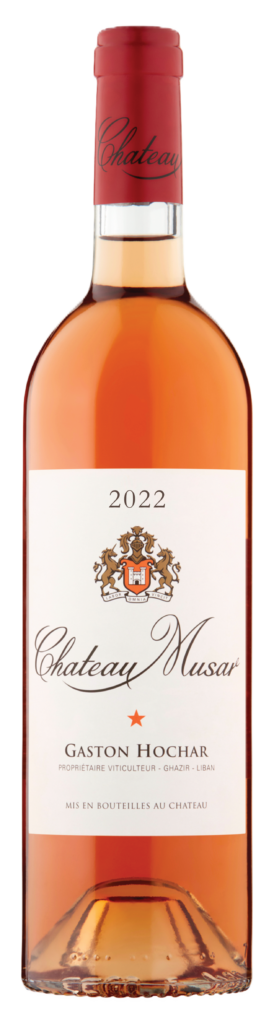
Chateau Musar Rosé is a still and softly‑oaked tribute to the ‘blended’ rosés of Champagne, a style much enjoyed by Serge Hochar. As a result, it is not made every year because specific grape qualities are needed for the varieties to combine in elegant form. In their youth, the wines are salmon pink, smooth, well‑balanced and velvety‑textured. They also show aromas and flavours of peaches, pears, oranges, grapefruit, almonds, wild herbs and citrus leaves. Over time, they develop mellow, spicy notes and tawny hues.
The main components are Obaideh and Merwah, indigenous to the mountains of Lebanon and said to be related to Chardonnay and Semillon. Planted between 1920 and 1947, the Obaideh vineyards lie in the foothills of the Anti‑Lebanon mountains on stony, chalky soils. Meanwhile, the Merwah vines grow on the seaward side of Mount Lebanon on calcareous gravels. Because yields are very low for these untrained bushvines, production ranges from 15 to 25 hl per hectare. At around 1400m, the vines remain on their own roots, placing them among very few vineyards of this calibre. Finally, around 5% of southern red Rhône grape Cinsault gives the wine its subtle colour.
The wine ferments and ages for 6 to 9 months in French oak barrels from the forest of Nevers. After that, it is bottled a year after the harvest and released for sale two years later.
To keep the wines showing at their best, bottles should be cellared in darkness, lying on their sides and kept away from movement or temperature fluctuations. By doing so, the wine retains its purity and ageing potential.
For vintages beyond 15 years of age, we recommend the use of prongs. If needed, a tutorial is available on our YouTube page A Guide to Wine Openers.
Complex and concentrated, Chateau Musar Rosé shows at its best after several hours of breathing time. In addition, it should be served ‘cellar cool’ at 15°C. Because of its citrusy flavours, it excels with canapés, olives, nuts, seafood and Provençal dishes.
“Musar’s whites and rosés are less well‑known. More’s the pity: both are unusual and superb.” – Andrew Jefford, Decanter, January 2004.
